
Synthetic Teak vs. Marine Carpet: Which Is Right for Your Boat?
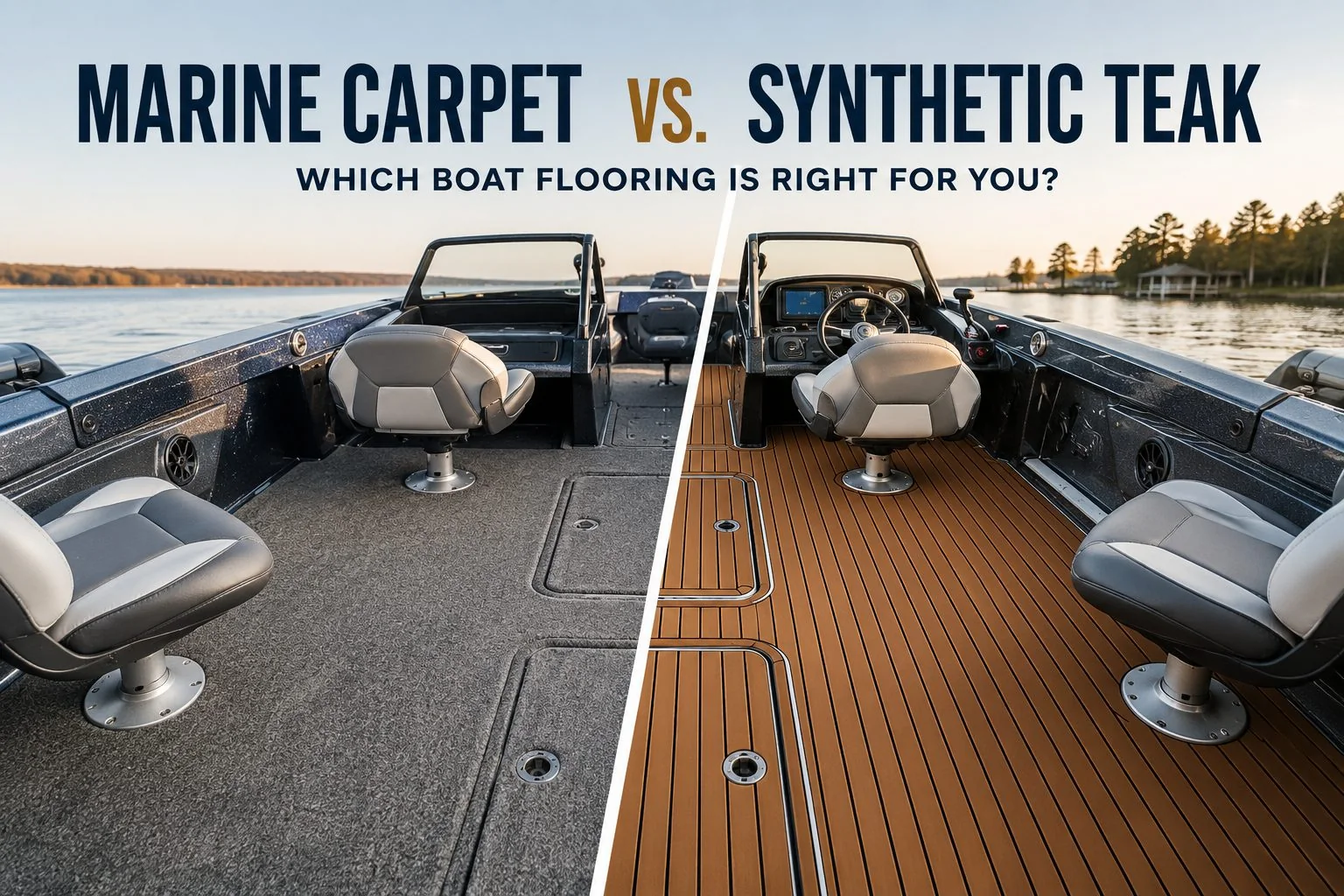
Marine carpet and synthetic teak solve very different problems.
Carpet emphasizes softness, familiarity and usually a lower initial material cost.
Synthetic teak emphasizes a firmer, custom-designed marine deck with plank, caulking and border details.
If you’re replacing old boat or pontoon carpet, the right choice depends less on which material is “better” and more on how you want the boat to feel, look and function.
The Short Answer
Choose marine carpet if your priorities are
- Softness
- Familiar feel
- Traditional pontoon/runabout appearance
- Lower initial project cost
Consider synthetic teak if your priorities are
- Teak-inspired appearance
- Non-textile deck surface
- Custom plank design
- Borders and caulking
- Coordinating several areas
- A more dramatic visual transformation
Key takeaways
- Carpet prioritizes softness and familiarity; synthetic teak prioritizes a custom marine-deck look.
- Cleaning and moisture behavior differ between textile and non-textile surfaces.
- Partial upgrades can work when transitions and adjacent flooring still feel intentional.
| Consideration | Marine carpet | Synthetic teak |
|---|---|---|
| Material | Textile marine carpet | Manufactured marine decking |
| Surface feel | Soft | Firm |
| Appearance | Traditional / continuous | Teak-inspired plank-and-caulking |
| Water behavior | Fibers/backing can retain moisture depending on product and conditions | Non-textile surface |
| Drying | Depends on product, ventilation and exposure | Surface water can drain or evaporate depending on layout and exposure |
| Routine cleaning | Vacuum, rinse, brush, extract or spot-clean depending on manufacturer | Manufacturer-approved surface cleaning |
| Sand / debris | Can settle into fibers | Visible surface debris is generally easier to identify than debris within carpet fibers |
| Staining considerations | Varies by carpet, product and contaminant | Product- and contaminant-specific; follow manufacturer guidance |
| Customization | Color and style | Color, caulking, borders, planks, panels and design |
| Installation | Removal, fitting, seams, adhesive, furniture access | Removal/preparation, measurement or templating, fabrication and bonding |
| Partial projects | Possible depending on transitions | Often possible |
| Initial cost | Often lower than custom synthetic teak | Generally a premium custom-decking category |
| Long-term care | Textile cleaning and drying | Product-specific surface care |
| Ideal buyer | Owner who prioritizes softness and familiarity | Owner focused on premium marine-deck styling |
Material
- Marine carpet
- Textile marine carpet
- Synthetic teak
- Manufactured marine decking
Surface feel
- Marine carpet
- Soft
- Synthetic teak
- Firm
Appearance
- Marine carpet
- Traditional / continuous
- Synthetic teak
- Teak-inspired plank-and-caulking
Water behavior
- Marine carpet
- Fibers/backing can retain moisture depending on product and conditions
- Synthetic teak
- Non-textile surface
Drying
- Marine carpet
- Depends on product, ventilation and exposure
- Synthetic teak
- Surface water can drain or evaporate depending on layout and exposure
Routine cleaning
- Marine carpet
- Vacuum, rinse, brush, extract or spot-clean depending on manufacturer
- Synthetic teak
- Manufacturer-approved surface cleaning
Sand / debris
- Marine carpet
- Can settle into fibers
- Synthetic teak
- Visible surface debris is generally easier to identify than debris within carpet fibers
Staining considerations
- Marine carpet
- Varies by carpet, product and contaminant
- Synthetic teak
- Product- and contaminant-specific; follow manufacturer guidance
Customization
- Marine carpet
- Color and style
- Synthetic teak
- Color, caulking, borders, planks, panels and design
Installation
- Marine carpet
- Removal, fitting, seams, adhesive, furniture access
- Synthetic teak
- Removal/preparation, measurement or templating, fabrication and bonding
Partial projects
- Marine carpet
- Possible depending on transitions
- Synthetic teak
- Often possible
Initial cost
- Marine carpet
- Often lower than custom synthetic teak
- Synthetic teak
- Generally a premium custom-decking category
Long-term care
- Marine carpet
- Textile cleaning and drying
- Synthetic teak
- Product-specific surface care
Ideal buyer
- Marine carpet
- Owner who prioritizes softness and familiarity
- Synthetic teak
- Owner focused on premium marine-deck styling
Appearance: The Biggest Difference
Marine carpet visually reads as interior flooring. Synthetic teak visually reads as marine decking.
That distinction matters. If your boat already has modern upholstery, an upgraded helm, a premium exterior finish, new canvas or updated lighting, old carpet can become one of the strongest remaining visual cues that the boat is older.
Synthetic teak can create a much more dramatic change because the deck itself becomes a design feature.
Comfort: Carpet Wins on Softness
If softness underfoot is your number-one priority, carpet has a legitimate advantage.
It can be especially appealing on family pontoons, boats where children sit or play on the deck, and for owners who prefer a textile feel.
Synthetic teak is intentionally firmer and more deck-like.
Cleaning: Textile vs Non-Textile
This is less about “good” versus “bad” and more about cleaning style.
Carpet can require vacuuming, brushing, extracting and drying depending on contamination.
Synthetic teak typically involves manufacturer-approved surface cleaning. Owners who regularly deal with sand, food, lake debris and wet traffic may prefer a non-textile surface.
What About Pontoon Carpet?
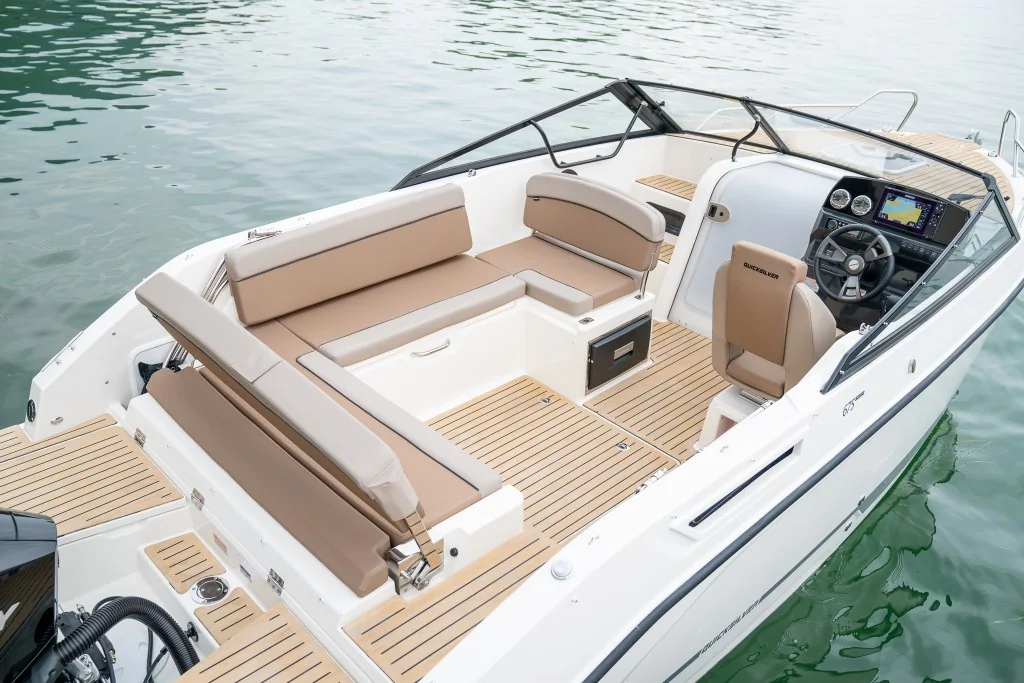
Pontoon owners are among the most likely to compare these materials because carpet can cover such a large percentage of the visible interior.
Replacing pontoon carpet with synthetic teak can create a significant visual change, but project scope may also be larger due to furniture, helm, gates, hardware, adhesive removal, deck preparation and total square footage.
Can Synthetic Teak Be Installed Where Carpet Was?
Potentially. The old carpet and adhesive generally need to be removed and the underlying surface evaluated.
Do not assume that removing carpet reveals a surface ready for immediate installation. Preparation may involve adhesive removal, cleaning, leveling, addressing previous repairs and evaluating hardware or transitions.
Which Costs More?
Synthetic teak will generally represent a larger custom-project investment than basic marine carpet.
Avoid comparing only raw material square-foot price. Compare removal, preparation, material, measurement, fabrication, furniture access, installation, design and the expected ownership and care routine.
Explore flooring options and pricing.

Who Should Choose Marine Carpet?
- Owners prioritizing softness
- Owners happy with the traditional carpet look
- Budget-conscious refreshes
- Boats where carpet remains appropriate to the use case
Who Should Consider Synthetic Teak?
- Owners seeking a major cosmetic upgrade
- Owners who prefer a non-textile surface
- Owners wanting coordinated cockpit/platform flooring
- Owners attracted to teak-style marine decks
- Owners who value custom plank design
Synthetic Teak vs Marine Carpet FAQs
Is synthetic teak easier to clean than carpet?
Cleaning styles differ. Carpet often involves textile cleaning and drying; synthetic teak typically uses manufacturer-approved surface cleaning. Which feels easier depends on your contaminants, exposure and preferences.
Can pontoon carpet be replaced with Flexiteek?
Often yes, after carpet and adhesive removal and surface evaluation. Scope can be larger on pontoons because of furniture, access and square footage. See the pontoon flooring page.
Is synthetic teak softer than carpet?
No. Carpet generally wins on softness. Synthetic teak is intentionally firmer and more deck-like.
Does synthetic teak hold water like carpet?
Synthetic teak is a non-textile surface. Carpet fibers and backing can retain moisture depending on product and conditions. Layout, drainage and exposure still matter for any deck.
Do I need to replace all of the carpet at once?
Not necessarily. Partial projects can work when transitions and adjacent flooring allow the new area to feel intentional.