
Looking for an Alternative to EVA Foam Boat Flooring?
EVA foam is popular for a reason. It can be lightweight, cushioned, comfortable and highly customizable.
But not every boat owner wants a foam deck forever.
If your existing flooring is aging—or you simply want a firmer, more traditional marine-deck appearance—Flexiteek synthetic teak offers a very different flooring direction worth comparing.
Key takeaways
- EVA foam and synthetic teak solve different priorities: cushioning vs. teak-inspired deck styling.
- Owners may consider a change when foam is worn, dated, or no longer matches the boat.
- Existing foam and adhesive generally need removal before a replacement surface is installed.
Why Boat Owners Choose EVA Foam
EVA foam became popular across recreational boating because it combines several appealing characteristics:
- Cushioned feel
- Lightweight construction
- Tactile surface
- Sport-oriented styling
- Broad color and pattern possibilities
- Custom-cut panels
- Comfortable standing areas
Quality matters. So do color, exposure, adhesive, installation, traffic and maintenance. For that reason, Wave Maker Craft does not treat every EVA flooring system as though it performs identically.
Why Some Owners Eventually Want Something Different
Choosing a different flooring material does not necessarily mean the previous material “failed.” Sometimes the owner’s priorities change.
You may be considering an EVA alternative because the existing flooring is worn, edges or panels have become damaged, the color no longer complements the boat, you’re updating upholstery or other finishes, you want a firmer surface, you prefer a more traditional yacht-inspired appearance, you want plank and caulking details, or you’re coordinating several boat areas into one design.
That is where synthetic teak enters the conversation.
EVA Foam and Synthetic Teak Are Not the Same Product
| Factor | EVA Foam | Synthetic Teak |
|---|---|---|
| Surface | Cushioned | Firmer marine decking |
| Appearance | Sport / contemporary / graphic | Plank-and-caulking teak-inspired design |
| Construction | Foam panels | Fabricated synthetic decking |
| Customization | Colors, routing, patterns, logos | Colors, caulking, borders, plank direction, logos and panel layout |
| Typical appeal | Comfort and sport styling | Premium marine-deck appearance |
Surface
- EVA Foam
- Cushioned
- Synthetic Teak
- Firmer marine decking
Appearance
- EVA Foam
- Sport / contemporary / graphic
- Synthetic Teak
- Plank-and-caulking teak-inspired design
Construction
- EVA Foam
- Foam panels
- Synthetic Teak
- Fabricated synthetic decking
Customization
- EVA Foam
- Colors, routing, patterns, logos
- Synthetic Teak
- Colors, caulking, borders, plank direction, logos and panel layout
Typical appeal
- EVA Foam
- Comfort and sport styling
- Synthetic Teak
- Premium marine-deck appearance
Neither category automatically wins. The right choice depends on what you want from the boat.
Replacing Existing EVA Foam
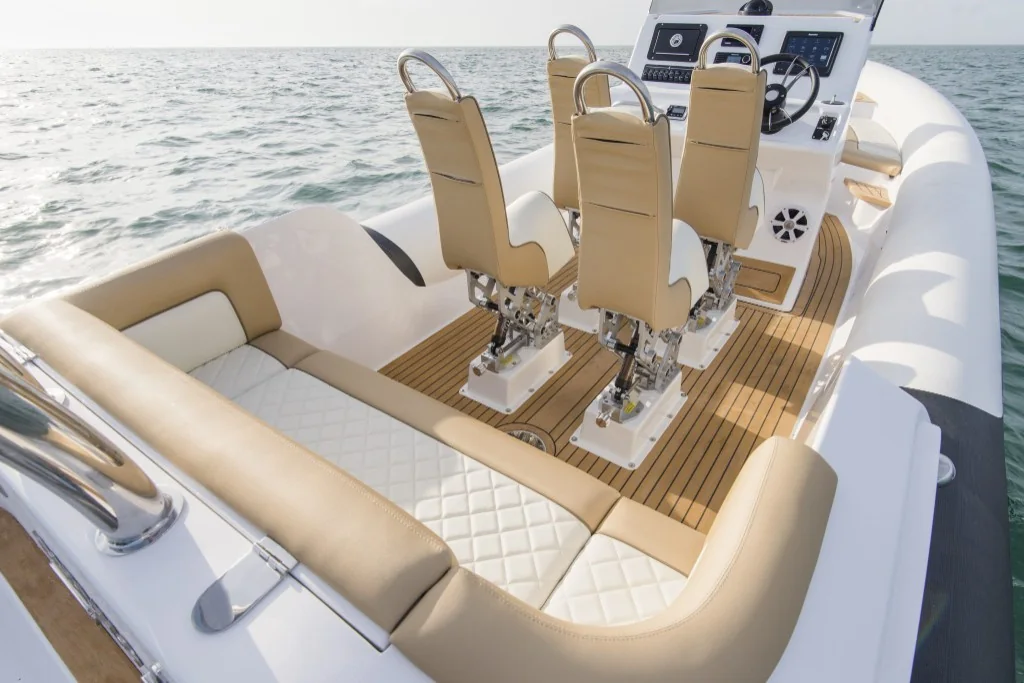
If you’re removing an existing foam floor, what is underneath matters. Adhesive residue, surface condition, previous preparation and deck construction can all influence the next flooring system.
A replacement project may require evaluation of existing foam, removal, adhesive cleanup, surface preparation, measurement or templating, new flooring design, fabrication and installation.
Avoid selecting replacement material based solely on how the old flooring looks from the top.
What About Heat?
Any boat deck can become warm or hot in direct summer sun. Surface temperature depends on material, color, sun intensity, air temperature, duration of exposure, airflow, shade and surface condition.
Do not assume that every EVA product or every synthetic-teak color performs the same way.
Flexiteek reports that its current Flexiteek 3 decking was independently tested for cooling performance and can cool up to 30% faster than the first-generation fossil-fuel PVC decking alternatives used in its comparison testing. That claim belongs to Flexiteek and should be reviewed against current manufacturer documentation; it is not the same as claiming Flexiteek is “30% cooler than EVA.”
What About Grip?
Both EVA foam and marine synthetic decking can provide useful underfoot grip depending on product and conditions. Flexiteek reports independently tested anti-slip performance for Flexiteek 3.
Never call any boat flooring “slip-proof.” Water, sunscreen, cleaners and other contaminants can affect any walking surface.
Who Might Prefer EVA Foam?
EVA may remain the better choice for owners who prioritize softer cushioning, sport appearance, routed graphics, lightweight foam construction, or helm or standing-pad comfort.
Who Might Prefer Synthetic Teak?
Synthetic teak may appeal more to owners who prioritize teak-inspired appearance, plank direction, defined caulking, borders and margin details, coordinated marine-deck styling, a firmer deck feel, or full cockpit/platform visual continuity across areas such as the swim platform and cockpit.
Before You Replace Your Foam Flooring
Send Wave Maker Craft your boat make/model/year, photos of the existing EVA flooring, close-ups of damaged or lifting areas, areas you want to replace, boat location, approximate project size and preferred colors or design inspiration.
This helps determine whether you’re looking at a straightforward cosmetic change or a project that may require more extensive preparation.
EVA Foam Replacement FAQs
Does all EVA foam peel?
No. Foam performance depends on the specific product, adhesive, surface preparation, installation, environment, traffic and care.
Can EVA foam be replaced with synthetic teak?
Potentially, yes. Existing foam and adhesive generally need to be removed and the underlying surface evaluated before a new flooring system is installed.
Is synthetic teak cooler than EVA foam?
There is not one universal answer across every EVA and synthetic-teak product. Product, color and exposure matter. Flexiteek’s published cooling claim compares Flexiteek 3 with specified alternative decking systems—not all EVA products.
Which is softer?
EVA foam is a cushioned material and will generally provide a softer feel than synthetic teak.
Which looks more like a traditional teak deck?
Synthetic teak is specifically designed around a plank-and-caulking marine-deck appearance.
Looking for service in your area?
Explore the local EVA-alternative page that best matches your boating market.
View local marine flooring options
View local marine flooring options