
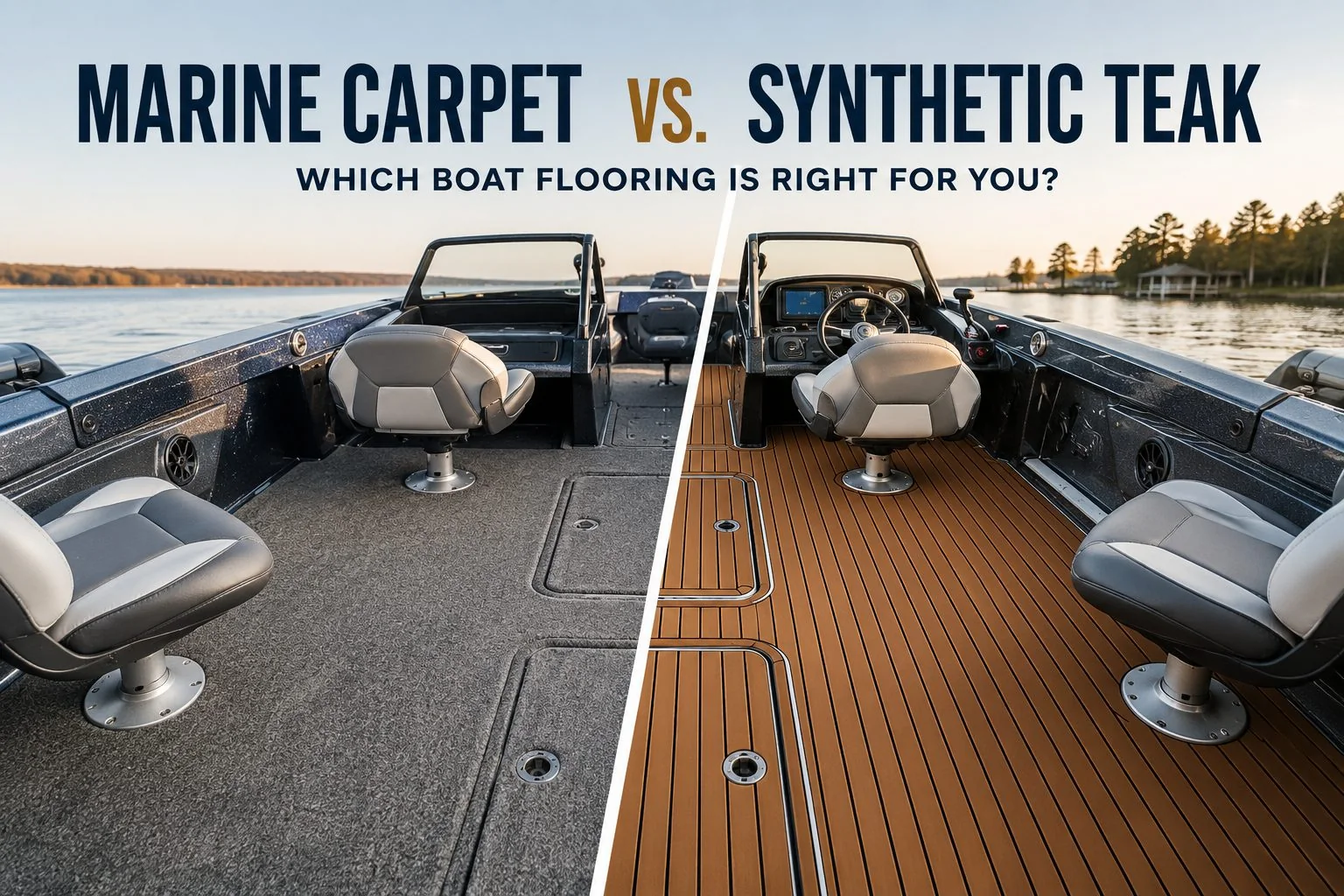
Walk through almost any marina and you’ll see boats at every stage of life.
Some look brand new despite being ten years old. Others have faded, stained decks that make an otherwise beautiful boat feel neglected.
Flooring condition can materially affect that first visual impression, alongside upholstery, gelcoat, hardware, and overall care.
Your deck is one of the largest visual surfaces on your boat. It’s also where every fishing trip, sunset cruise, family outing, and day at the sandbar begins. Choosing the right flooring isn’t simply about aesthetics; it’s about comfort, safety, maintenance, and how much you enjoy your time on the water.
Marine carpet remains a familiar choice on many recreational boats. Owners considering replacement may compare new carpet with vinyl, EVA foam, molded surfaces, and synthetic teak.
If you’re considering upgrading your boat, here’s everything you should know before making your decision.
Why Your Boat’s Flooring Matters More Than You Think
It’s easy to overlook the deck when planning upgrades.
Many owners focus on electronics, speakers, trolling motors, lighting, or upholstery. While those improvements certainly add value, none of them have the immediate visual impact of new flooring.
Think about it.
The moment someone steps aboard, they’re standing on your deck.
It’s where people gather, fish, relax, dance, eat, and make memories.
Fresh flooring transforms the entire experience.
Understanding Marine Carpet
Marine carpet became popular because it was relatively affordable and offered a soft walking surface.
For years, it served boat owners well—but boating has changed, and so have flooring materials.
Advantages of Marine Carpet
Marine carpet does have a few benefits.
It provides:
- A soft surface underfoot
- Familiar appearance
- Lower upfront cost
- Good insulation from hot decks
- Comfortable seating for children
For certain older fishing boats and pontoons, carpet may still make sense depending on budget and intended use.
However, there are tradeoffs.
The Downsides of Marine Carpet
Carpet construction, backing, installation, storage, and drying conditions affect ownership. Fibers may retain:
- Dirt
- Mud
- Fish blood
- Sand
- Leaves
- Bait residue
- Moisture
Some contaminants can become embedded in the fibers, making complete cleaning more difficult.
Then there’s mildew.
If carpet and backing remain damp, mold, mildew, or odors may develop depending on climate, storage, ventilation, and cleaning.
Traffic and care can also affect pile appearance over time.
Enter Synthetic Teak
Synthetic teak is now available across a broad range of recreational-boat applications and is often compared with carpet by owners who want a different appearance and cleaning routine.
Originally seen primarily on luxury yachts, advances in marine materials have made premium synthetic teak accessible for everything from fishing boats and pontoons to wake boats and center consoles.
It delivers the elegant appearance of real teak without the maintenance that natural wood requires.
Just as importantly, it’s engineered specifically for life on the water.
A Premium Look Without the Premium Maintenance
Natural teak is stunning.
It’s also expensive.
Maintaining real teak requires regular:
- Cleaning
- Sanding
- Oiling
- Sealing
Synthetic teak offers a teak-inspired appearance with a different care routine. It is not maintenance-free, and the current product guide should control.
Cleaning Is Surprisingly Simple
A non-textile surface can change the cleaning process.
After a long day on the water, your deck may have:
- Sunscreen
- Wet footprints
- Fish scales
- Food spills
- Salt spray
- Muddy paws
- Cooler marks
Routine soil may respond to a manufacturer-approved basic cleaning method, while difficult spills can require specific treatment.
Use the current manufacturer-approved cleaner and method for the exact product and stain.
Unlike carpet, there are no textile fibers to scrub. Seams, residue, surrounding materials, and product-specific instructions still matter.
Durability That Matches Your Lifestyle
Boat owners don’t buy boats to keep them covered in storage.
They buy them to use them.
That means flooring must withstand:
- Bright sunlight
- Saltwater
- Freshwater
- Heavy foot traffic
- Fishing gear
- Water toys
- Pets
- Coolers
- Chairs
- Anchors
- Everyday wear
Premium synthetic teak is engineered specifically for these environments.
Unlike textile carpet, synthetic teak provides a non-textile surface. Water behavior, seams, bonding, residue, mold or mildew conditions, and cleaning still depend on the product, installation, environment, and care.
Service life and appearance depend on product, preparation, installation, exposure, traffic, storage, and care.
Comfort Where It Counts
Every flooring material feels different.
Marine carpet offers softness.
Synthetic teak offers a different textured surface.
Its textured surface is designed for marine use, but no deck is slip-proof. Water, soap, sunscreen, algae, residue, wear, footwear, and conditions affect footing.
Surface selection and wet-condition caution are especially relevant on:
- Swim platforms
- Cockpits
- Bow seating
- Walkways
- Fishing decks
It’s one of those upgrades people don’t fully appreciate until they experience it.
Which Flooring Looks Better?
Beauty is subjective.
But there’s a reason luxury boat builders continue embracing teak-inspired decking.
Synthetic teak creates clean visual lines that instantly elevate the appearance of nearly any boat.
The custom plank layout, contrasting caulk lines, and precision fit give boats a premium, finished appearance.
It’s an upgrade people notice immediately.
Marine carpet, while functional, generally creates a more traditional look that may begin showing age sooner.
Comparing Marine Carpet and Synthetic Teak
| Feature | Marine Carpet | Synthetic Teak |
|---|---|---|
| Appearance | Traditional | Premium yacht-inspired |
| Cleaning | Fibers and backing can require extraction and thorough drying | Non-textile surface; follow product- and stain-specific guidance |
| Water Behavior | Depends on fiber, backing, seams, installation, and drying | Depends on product, seams, bonding, substrate, and installation |
| Mold & Mildew Considerations | Fibers and backing may retain moisture; drying and cleaning matter | Non-textile surface; installation, residue, environment, and cleaning still matter |
| UV Exposure | Performance depends on the carpet product, color, storage, and exposure | Performance depends on the synthetic-teak product, color, storage, and exposure |
| Fish Residue Cleanup | Fibers can require prompt, thorough cleaning | Use the exact manufacturer-approved stain method |
| Long-Term Appearance | Depends on product, traffic, exposure, drying, and care | Depends on product, installation, traffic, exposure, and care |
| Custom Design Options | Color, texture, binding, and fit vary by supplier | Color, caulking, borders, layouts, and details may be available |
| Resale Presentation | Condition and fit with the boat matter | Condition, design, documentation, and buyer preference matter |
Is Synthetic Teak Worth the Investment?
The answer depends on how you use your boat.
Consider which ownership priorities matter to you:
- Initial and complete installed cost
- Appearance and customization
- Surface feel and temperature
- Cleaning and drying expectations
- Partial versus full replacement
Those ownership priorities matter regardless of any future resale decision. No material guarantees a particular return.
When Synthetic Teak May Fit
Synthetic teak may fit owners who want:
- A teak-inspired plank appearance
- Match their expected ownership period and use
- Require less maintenance
- Improve comfort
- A coordinated finish without assuming a resale return
- Enhance the overall boating experience
Other owners may prefer carpet’s softness and lower initial material cost. The right answer depends on the exact products, boat, use, exposure, budget, and project scope.
Why Choose Wave Maker Craft?
At Wave Maker Craft, we believe every boat deserves craftsmanship that reflects the pride of its owner.
The team can help define the boat, project area, material direction, samples, measurements, photos, location, and written scope. Confirm who is responsible for removal, preparation, templating, fabrication, adhesive, shipping, and installation before purchase.
Frequently Asked Questions
Is synthetic teak hotter than marine carpet?
Surface temperatures vary with material, color, direct sun, weather, airflow, and moisture. Compare samples where practical and check any deck before barefoot use.
Does synthetic teak stain easily?
Stain behavior varies. Treat spills promptly and use the current manufacturer-approved method for the exact product and substance.
Can synthetic teak be installed over existing flooring?
Every boat is different. During a consultation, we’ll evaluate your current deck and recommend the best installation method for long-term performance.
How long does marine carpet typically last?
The lifespan depends on storage, usage, and maintenance, but many owners replace marine carpet due to fading, staining, mildew, or wear rather than structural failure.
Is synthetic teak only for expensive boats?
No. Compatibility and service availability depend on the boat, substrate, project area, access, location, and written scope—not simply the boat’s price.
Upgrade the Part of Your Boat You Use the Most
Every boating adventure begins the moment you step aboard.
Why not make that first step one you’re proud of?
Whether you’re replacing worn marine carpet or planning a complete boat refresh, custom synthetic teak flooring is one of the most rewarding upgrades you can make.
At Wave Maker Craft, we’re passionate about helping boat owners transform their vessels into something they’ll love for years to come.
Compare the full decision in the synthetic teak vs. marine carpet guide. Lake of the Ozarks boat owners can then request a project-specific marine-flooring quote.